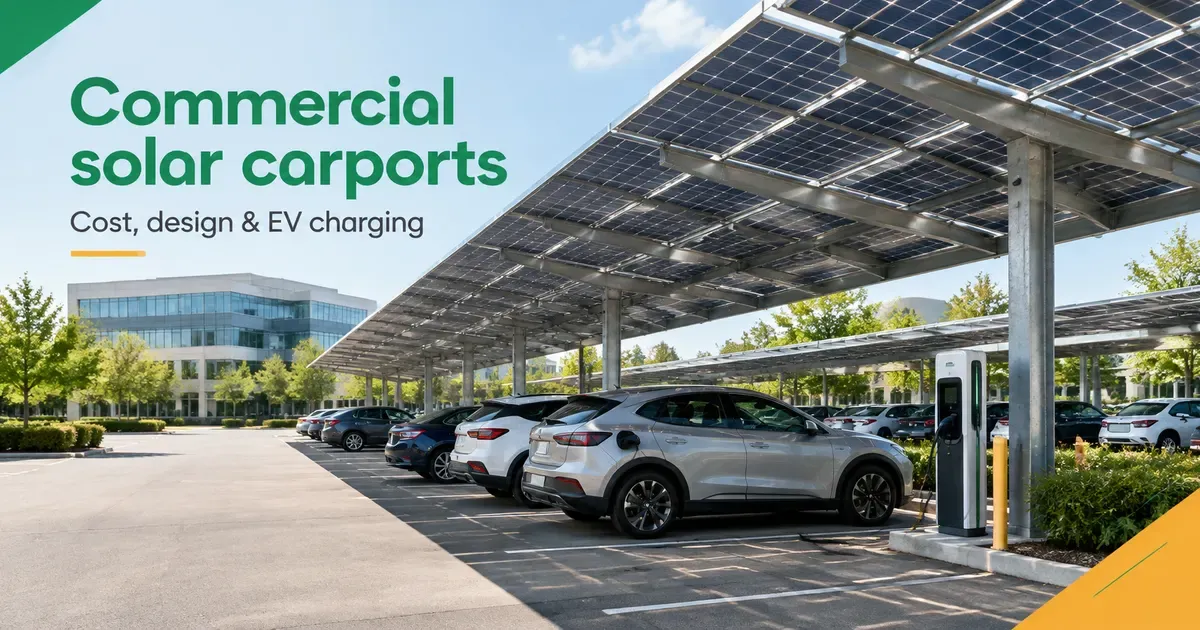
Solar Carports for Commercial Parking Lots – Costs, Design and EV Charging
Are Solar Carports Right for Commercial Parking Lots?
Solar carports for commercial parking lots place photovoltaic panels on an engineered canopy above parking spaces. They combine vehicle shelter with electricity generation and can support an EV charging installation. They are worth assessing when a business needs parking shade, has limited usable roof space or can consume solar electricity during the day.
A carport is not simply a rooftop array lifted onto taller legs. Columns, foundations, beams, wind resistance, drainage and vehicle movement are part of the project. That additional construction makes a conventional rooftop price an unreliable quote for a complete parking canopy.
This guide is for facility managers, offices, factories, hospitals and other businesses considering commercial solar carports. For domestic parking, see our separate solar carport for home guide. To discuss a surveyed installation in Odisha or West Bengal, visit StellarGreen solar carport installation.
How a Solar Parking Canopy Supplies a Business
Solar modules produce DC electricity, and a compatible inverter converts it to AC for the site's electrical system. The design determines how generation serves building loads, EV charging and any permitted grid export. A battery can be considered separately, but is not automatically included.
The Ministry of Power's September 2024 EV charging guidelines describe solar carports as dual-purpose structures that shelter vehicles and generate renewable energy, including for on-site EV charging [1]. That recognition is not a blanket planning permission, subsidy sanction or assurance that every parking layout is suitable.
Start by comparing generation hours with the facility's load. An office with daytime air conditioning and employees charging cars has a different demand profile from a venue mostly used at night. If export compensation is limited, simultaneous consumption can matter more than maximising installed panel capacity.
Solar Carport Cost in India: What Must Be Quoted?
There is no defensible single solar carport cost in India for every commercial site. The steel span, foundations, ground conditions, capacity, drainage standard and electrical connection can change the total materially. StellarGreen does not publish a verified all-inclusive carport rate here; request a site-specific engineered quotation.
| Cost package | Include in the scope | Common omission |
|---|---|---|
| Solar equipment | Modules, inverter, mounting interfaces and monitoring | Confusing module-only prices with an operating system |
| Canopy and civil work | Steel, corrosion protection, foundations and construction | Unspecified ground conditions or drainage |
| Electrical connection | Cables, protection, earthing, integration and metering work | Long cable runs or required supply upgrades |
| EV charging | Chargers, distribution, protection and load management | Charging software, networking and recurring costs |
| Operations | Access, cleaning plan, maintenance and warranty responsibilities | Assuming every component has the panel warranty |
Ask for the solar-generation package, structural package and charging package as separate subtotals. This lets you compare a solar panel parking shed with an ordinary parking canopy plus rooftop solar without hiding the cost of the shelter itself.
All prices mentioned on the website are exclusive of taxes and may vary based on location, state regulations, and actual site requirements.
Our commercial solar cost guide discusses rooftop budgeting, not a guaranteed carport price. Do not copy its per-kW figures into a parking proposal without adding the surveyed structure and civil works.
Design the Parking Layout Before Choosing Capacity
Measure usable parking rows, access lanes, turning space, vehicle heights and pedestrian paths. Mark fire access, emergency routes, accessible spaces and existing drains. A design that adds generation while making vehicles harder to park is not a successful commercial solution.
Column placement and canopy height need to suit the actual vehicles, including service vans where relevant. Cantilever and multi-column arrangements offer different trade-offs in clear space, span and structural cost. Do not choose a layout solely because an illustration shows fewer columns.
Calculate capacity from the selected modules and an approved layout, not a fixed number of kilowatts per parking bay. Module dimensions, tilt, shading, gaps and maintenance access all affect the number that fits. Keep the generation forecast separate from the rated capacity.
Structure, Wind, Drainage and Coastal Conditions
Have a qualified engineer assess canopy loads, wind uplift, stability, connections and foundation requirements under the applicable design standards. Ground conditions may require investigation before foundations can be priced properly. Open-sided canopies face wind exposure differently from modules mounted close to a roof.
For coastal Odisha and West Bengal, discuss local wind conditions and corrosion protection explicitly. Ask what coating or galvanising specification is proposed, how cut edges and connections are protected, and how the structure will be inspected. A generic “weatherproof” label is not a structural specification.
Panels do not automatically form a watertight roof. If dry parking is required, specify a sealed roofing solution, gutters, downpipes and the destination of runoff. Keep water away from electrical equipment and pedestrian areas, and preserve safe cleaning access.
Solar Carport with EV Charging: Size the Electrical Load
A solar carport with EV charging requires more than matching the number of chargers to the number of cars. List the vehicles, expected arrival and departure times, energy needed per visit and supported charging rates. Then assess the building's existing load and available electrical capacity.
For illustration only, four chargers each rated at 7.4 kW could request 29.6 kW if all operate at full power simultaneously. That is electrical demand, not daily energy consumption and not a requirement to install exactly 29.6 kW of solar. Compatible vehicles may draw less, while load management can limit the combined demand.
Solar output varies with sunlight; an on-grid charging installation can draw the balance from the grid subject to its supply design. Night charging cannot use daytime generation directly without storage. A battery adds cost, conversion losses, protection requirements and an operating strategy that needs its own assessment.
The Ministry of Power guidelines cover private, semi-public and public charging contexts [1]. Confirm the requirements for your operating model, including safety, connection, metering and any local permissions, before offering paid public charging.
Assess Savings Without Promising a Fixed Payback
Build a financial model using the site's generation estimate, coincident consumption, electricity tariff, export treatment and maintenance costs. Treat charging income separately, deducting energy purchases, payment fees, software costs and operating expenses. A busy parking lot does not automatically become a profitable charging business.
For a hypothetical calculation, 40,000 kWh of annual solar electricity actually replacing purchases valued at ₹8 per kWh would avoid ₹3,20,000 of energy purchases before operating costs. These are illustrative inputs, not a generation forecast or a confirmed tariff. Value exported energy using the actual approved settlement rules instead.
Include the canopy's shelter value where it meets a real need, but do not present that value as electricity savings. Compare the complete carport investment with alternatives such as conventional shade plus rooftop solar. Model maintenance and replacement costs over time rather than quoting one guaranteed payback period.
Subsidy, Approvals and Procurement Checklist
Do not apply the individual household PM Surya Ghar subsidy to an ordinary commercial parking installation. Residential assistance and a business's solar project are different categories. Any incentive or tax treatment requires separate eligibility confirmation; charging provision alone does not establish entitlement.
- Confirm land rights, parking use, planning requirements and required permissions.
- Obtain the structural design basis and a clear division of engineering responsibilities.
- Check grid connection, export arrangement and available supply capacity.
- Agree construction phasing to keep essential parking and access operational.
- Specify equipment, corrosion protection, drainage and electrical safety.
- Separate charger hardware, software subscriptions and public charging operations.
- Record commissioning tests, warranty claims and maintenance responsibilities.
For local business planning, explore Balasore commercial solar, Cuttack commercial solar or Howrah commercial solar. A local assessment should address the specific site rather than reusing a standard parking diagram.
Frequently Asked Questions About Commercial Carports
Are carports cheaper than rooftop solar?
Not necessarily. The canopy and foundations add work that an existing roof may not need. Compare complete scope and shelter value rather than panel price alone.
Can an existing parking shed support solar?
Only after structural and electrical assessment. Existing steel, foundations and connections may not have been designed for the added loads and wind effects.
Can every EV charge only from solar?
Only if available solar output and the designed charging arrangement meet the demand at that time. Grid supply or suitable storage can provide the balance; charger and vehicle limits still apply.
Does a canopy need batteries?
No, not by definition. Batteries are an optional design decision for a particular charging, backup or energy-management objective.
Reference and Next Step
Prepared on 26 November 2026. [1] Ministry of Power, Guidelines for Installation and Operation of Electric Vehicle Charging Infrastructure, 17 September 2024: beeindia.gov.in/WriteReadData/L45218/2841453721548450.pdf. Confirm subsequent amendments and local requirements before procurement.
Send your parking layout, electricity bills, vehicle mix and charging expectations to StellarGreen for a carport assessment. We can discuss the solar scope and site requirements without inventing a fixed cost or guaranteed return for an unmeasured project.