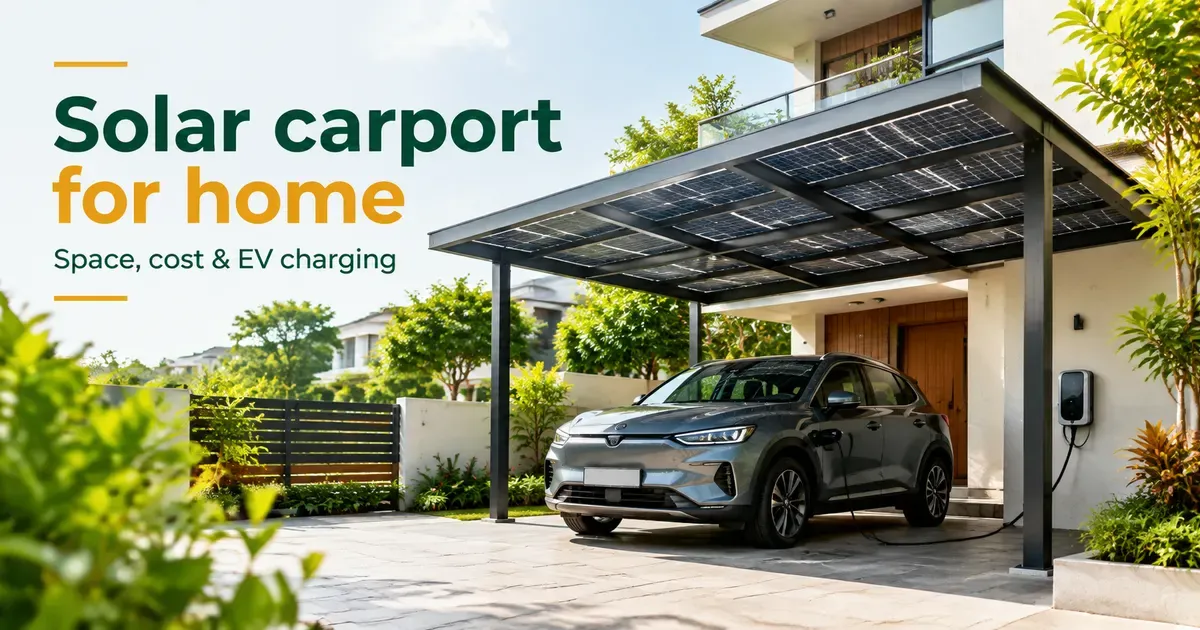
Solar Carport for Home in India – Cost, Space and EV Charging
What Is a Solar Carport for Home?
A solar carport for home is a parking canopy carrying photovoltaic panels above your car or driveway. It offers shelter and produces electricity for the household through a compatible solar system. It can also form part of a home EV charging design, but a charger or battery is not automatically included.
A residential solar carport is worth considering if your roof is shaded, crowded, inaccessible or unsuitable for panels and the driveway has good sunlight. It is not always the lowest-cost way to install solar: a new canopy requires structural and civil work that an existing suitable roof may not need.
This guide covers a household decision, not a commercial parking project. For offices or larger sites, read our commercial solar carport guide. For installation planning in Odisha and West Bengal, see StellarGreen solar carport services.
How Much Space Does a Single-Car Solar Carport Need?
There is no universal capacity that fits every single-car solar carport. Start with the vehicle dimensions, door-opening clearance, manoeuvring space, column positions and usable driveway boundary. Then use the actual panel dimensions and structural layout to calculate the available capacity.
As a measurement example only, a 3 m by 5.5 m canopy footprint is 16.5 square metres. That is gross footprint, not guaranteed usable panel area or proof that a particular system will fit. Overhangs, tilt, drainage, structural members and access requirements change the final design. Your vehicle may also require a different footprint.
For a solar carport for driveway installation, consider gate opening, pedestrian access and whether columns would obstruct turning. Mark underground services before planning foundations. Property boundaries and local setbacks must be checked rather than assumed from a photograph of another home.
Ask the installer to show a dimensioned drawing with the proposed panels and parking clearances. Do not accept “one bay equals 3 kW” as a substitute for a layout. Two neighbouring homes can need different structures even when both park one car.
Solar Carport Cost for Home: Separate Solar from Shelter
The solar carport cost for home includes both the generation system and the canopy supporting it. A complete offer should list panels, inverter, electrical protection, wiring, steel or other structural material, foundations, drainage, installation and commissioning. EV charging and batteries should be separate items.
StellarGreen's displayed residential rooftop planning budgets are ₹70,000 for 1 kW, ₹1,99,000 for 3 kW and ₹3,00,000 for 5 kW before subsidy. These are not complete carport quotations. A parking canopy can add structural, civil and connection costs that have not been surveyed or priced in these reference figures.
All prices mentioned on the website are exclusive of taxes and may vary based on location, state regulations, and actual site requirements.
| Quotation section | Questions to ask |
|---|---|
| Solar equipment | Which panel and inverter models, capacity and warranties are included? |
| Canopy | What spans, columns, foundations and corrosion protection are specified? |
| Rain protection | Is waterproof roofing included, or only panels on a frame? |
| Electrical work | Are cable routes, earthing, protection and meter-related work included? |
| EV charging | Are charger, supply upgrades and load management priced separately? |
| Aftercare | Who services the structure, inverter, panels and charger? |
For the underlying solar budget, read our home installation cost guide. Compare like-for-like written quotations and ask for taxes, exclusions, payment milestones and quote validity.
Carport or Rooftop Solar: Which Is Better for Your Home?
A suitable existing roof can avoid building a new parking structure. A carport may instead make sense when you already need a shelter and have an unshaded driveway. Compare the combined cost of shade and generation, not just the cost per watt of panels.
Shade from nearby buildings and trees can affect driveway solar even when the roof is sunny. Conversely, the roof may be unsuitable while the parking area has better exposure. A survey should check shading at different times and discuss future obstructions, such as tree growth or a planned building extension.
Access matters too. The installer needs safe routes for wiring, cleaning and maintenance. Read our home solar installation page for rooftop options and ask for both layouts if the property could support either approach.
Designing a Solar Panel Car Parking Shed for Home
A solar panel car parking shed for home must be engineered for the site, including wind uplift, canopy loads, connections and foundations. Do not assume an existing lightweight shed can carry panels safely. A qualified structural assessment can establish whether strengthening or a new structure is needed.
In coastal Odisha and West Bengal, ask specifically about wind exposure and corrosion protection. A tall open canopy has a different risk profile from panels placed close to a roof. Require an agreed material and coating specification rather than a vague statement that the shed is “strong enough”.
If you need rain protection, specify sealed roofing or an appropriate integrated system plus gutters and drainage. Gaps between ordinary panels can allow water through. Downpipes should not discharge across the driveway, onto chargers or onto a neighbour's property.
Keep vehicle-impact risks, child access, sharp edges and cable protection in the design discussion. Electrical equipment should be positioned for safe operation and maintenance, not wherever the remaining wall space happens to be.
Home Solar Carport with EV Charging
A home solar carport with EV charging can use daytime generation for charging when the vehicle is parked and the electrical system supports it. The charger must match the car, household supply and available load. Rated panel capacity does not mean that the same power is always available at the charging socket.
For illustration, adding 20 kWh to a vehicle at a steady 7.4 kW would take about 2.7 hours before charging losses and vehicle limitations. A smaller solar array will not necessarily supply that charger entirely from solar; the grid can provide the balance in a properly designed grid-connected installation.
Check when your car is actually home. If it leaves each morning and returns after sunset, daytime solar can serve household loads but cannot directly charge that car at night. Storage may shift energy, but it adds expense, losses and another system to maintain. A battery is not automatically the best financial answer.
The Ministry of Power's September 2024 charging guidelines cover private parking and recognise solar carports [1]. Confirm current electrical safety and connection requirements with the installer and electricity provider. Do not use a casual extension lead as a replacement for an approved charging installation.
Is a Home Solar Carport Eligible for Subsidy?
Do not assume eligibility merely because panels are mounted above a car. PM Surya Ghar assistance concerns eligible residential solar installations following the programme's technical and application requirements. Confirm acceptance of the proposed mounting arrangement and consumer category with the DISCOM before budgeting for assistance.
StellarGreen's guidance shows up to ₹1,38,000 in Odisha including applicable state support and up to ₹78,000 in West Bengal. Those are maximum benefits for eligible projects, not confirmed grants for every residential carport. Canopy construction, chargers and batteries should not be presumed subsidised.
Read the scheme and eligibility guide and the application checklist. Ask for written confirmation of the applicable process before ordering the structure or installing panels.
Generation, Savings and Backup: Keep Them Separate
A site-specific generation estimate should account for orientation, shade, weather and equipment losses. Savings then depend on how that generation overlaps with home consumption and how imports and exports are settled. Neither the number of cars nor the number of panels alone determines the bill reduction.
A standard grid-connected system normally shuts down during a power outage for safety. Charging during an outage or backing up household circuits requires suitable inverter, battery and isolation arrangements. Specify the exact backup loads rather than assuming the carport can power the whole property.
Use the solar calculator only for an initial rooftop estimate. Its output is not an engineered carport quote or an EV charging design. Replace assumptions with the surveyed layout and your actual electricity bills before deciding.
Frequently Asked Questions About Home Solar Carports
Can one parking bay hold enough panels for my house?
Possibly, but it depends on the canopy dimensions, panel layout and household consumption. A measured design is needed; there is no fixed household capacity per car space.
Will the panels keep the car completely dry?
Not automatically. Standard panels on a frame can leave gaps. Specify a waterproof canopy and drainage if rain shelter is a requirement.
Can I convert my existing car shed?
Only after structural assessment and a suitable electrical design. The shed's condition, foundations and load capacity need to be verified first.
Can my EV charge overnight from the carport?
Not directly from sunlight after sunset. A connected system can use grid electricity, while stored solar needs an appropriately sized battery and compatible equipment.
Reference and Home Assessment
Prepared on 26 November 2026. [1] Ministry of Power, Guidelines for Installation and Operation of Electric Vehicle Charging Infrastructure, 17 September 2024: beeindia.gov.in/WriteReadData/L45218/2841453721548450.pdf. Illustrations in this article explain space and charging arithmetic, not guaranteed layouts or output; cover imagery is illustrative, not a documented customer project.
For homes in Balasore, Kolkata or Midnapore, request a StellarGreen assessment with driveway measurements, vehicle details and recent electricity consumption.